
- Introduction
- Language Practices
- Positives
- Families Concerns and Questions
- Advice from parents to parents
- Bank of resources
1. Introduction
In May 2026, Ninho Ry association conducted a questionnaire for families living in Finland in multilingual and minority heritage language contexts, crafted by us interns, Tinka Kukkamäki and Inés De Luis Moro, who are studying for their master’s in education at Tampere and Helsinki Universities. The questionnaire received a wide range of insightful responses, with families sharing their experiences of everyday language use, different approaches to language learning, and the questions and hopes they encounter in daily family life.
Using the data collected, we have prepared this article. From Ninho Ry’s work with multilingual families, there was a clear need for accessible information, peer support, and information about events where families have opportunities to use their heritage and minority languages.
The aim of this text is to combine research-based perspectives with the experiences and reflections shared by the families themselves. We hope the themes presented here resonate with other multilingual families navigating through similar questions in their everyday lives, while also bringing attention to a broader discussion about multilingualism, identity and belonging. We also hope this text and the materials we have gathered will encourage curiosity and bring even greater awareness, that is, maintaining multiple languages and sharing the great gift of language across generations.
2. Language Practices
There are no right or wrong ways to support multilingualism in a family. Every family, situation and language journey is different, and the most important thing is to find those language practices that feel natural and sustainable for your family.
The questionnaire highlighted families’ interest in learning more about the different language practices and different ways of supporting language transmission. And in this chapter, we have gathered a short introduction to some of the different approaches to multilingual family life, that may help increase your awareness of the methods which could be present in your daily life.
OPOL – One Person One Language
This is one of the most known methods also known as ‘’One Parent One Language’’. In this approach each parent or guardian consistently uses one language when communicating with the child (Arnaus Gil, et al., 2021).
For example, the parents may speak different heritage languages, and each parent uses their own heritage language with the child in various everyday interactions. One of these languages may also be used as the family’s common language when everyone is together, or the family may agree to use a third language in situations where all family members are present.
T&P – Time and Place
Time and Place also known as ”’Context Based Language Use”, is a method where a family has decided when and where a language is spoken. This can be something that happens daily on different situations through routines, activities and/or locations.
For example, you may agree to use the minority language on specific days of the week, during specific activities such as dinner times, or during visits to relatives.
ML@H – Minority Language at Home
This method commonly known also as ‘’Heritage Language at Home’’, refers to a method where home is considered as a space where minority or heritage language is used as the primary language of communication in daily routines. Arnaus Gil et al. (2021) also mention in their research a somewhat contrasting approach to this method, known as multilingual home, in which the minority language is supported outside the home setting, for example through formal education.
For example, a Portuguese-speaking family may live in Finland, where the majority language is Finnish. In home settings Portuguese is used in everyday communication, while outside of home Finnish is used, for example when interacting with teachers, friends, etc.
Code switching
Code switching also sometimes known as ”Language Mixing”, is something that happens very often and can occur even in families where parents try keep their languages separate. This method refers to flexible language use, where both languages are used even in the same sentence. Code-switching can be conscious and systematic or more spontaneous. In code-switching a person can intentionally switch languages depending on context or the change of language can be unplanned and happen naturally.
For example, a speaker changes their language depending on the person they are talking to, or switch languages across sentences, such as asking a question in English and a follow up in another language, or just by using a single word in a sentence from another language.
Translanguaging
Translanguaging also known as ”Limittäiskieleily” in Finnish. Translanguaging is an approach where the speaker is purposely moving fluidly between languages to communicate, allowing the languages support one another rather than keeping them separate. This method has grown to be an important resource in multilingual learning environments, where children’s home languages are integrated into different environments in which other majority languages are used. The aim is to support both language development and the understanding of the subject being taught. Translanguaging views language as a whole unified system while as code-switching views language use as a separate use of languages.
For example, translanguaging is used to support understanding. Child may ask a question in their minority language, while a sibling answers using a combination of the minority and another language used at home. In school settings, translanguaging may come up when a child first asks to read a text in their heritage language, before completing the schoolwork in the majority language (Finnish or Swedish).
These different language practices are often associated by the amount and type of experiences that children are exposed to. Because of this, even similar practices can differ a lot between families. Verhagen et al. (2022) also brings out, how it can be a common misconception, that families should be limited to only one language practice, which is not true, since most of the time they can be intertwined.
Verhagen et al. (2022) also mention in their research, how one of the most important factors in language patterns is the exposure to languages, since it is very common, that family practices change overtime as children grow and family conditions evolve. Children are naturally very sensitive to languagesand easily adapt to different situations different ways to multilingualism.
And what is the most important is that each family finds the right methods of language exposure, that fit and suit them the best.
3. Positives
Speaking multiple languages in a family can sometimes seem chaotic. Even beyond the family context, switching languages or searching for the right word is a challenge. However, multilingualism can be a rewarding experience.
The answers received in this questionnaire show how intentional family time becomes with relatives who live apart. Holidays or family visits become an important opportunity to practise the minority language for our children, and words often take on sentimental value, songs sung by grandparents, games played with cousins… It has been demonstrated that transnational connections are a great opportunity for language socialisation and immersion.
In Finland, carrying different cultures is welcomed and celebrated. One positive part of the daycare or school experience here is the intercultural days, where cultures are shared and appreciated in the classroom. Students, teachers and parents have the opportunity to learn and teach their countries’traditions and heritage minority languages, empowering cultural identities and a sense of belonging. These activities are possible due to Finland’s educational system/curriculum. In the Metropolitan area, municipalities provide around 50 different Minority Heritage Language classes, also known asKotikieli courses, giving our children the opportunity to learn grammar and become more comfortable using their minority languages with other children while making friends.
Hollebeke and colleagues (2023) found that using multiple languages within families benefits cognitive abilities, including literacy, self-control, inhibition, vocabulary, creativity, math, school preparedness, and academic grade point average (GPA).
4. Families’ Concerns and Questions
- What should be the common language used in the family?
Research on language patterns in bilingual families shows that exposure is essential for both language development and maintenance. Children in Finland normally receive most of their input in the national languages, through daily interactions at school, on the playground, and in extracurricular activities. As their exposure to the majority language increases outside the home, the minority language can become less influential in their lives.
For this reason, families are encouraged to use the languages that need more support (often the minority languages). Different studies also suggest that when both parents consistently use the same language with the child, language development is more likely to be sustained. However, it has not been proved yet that parental language choices alone determine children’s language skills, as these are influenced by other factors as well.
There is no single “correct” language choice for every family. The best approach is the one that feels natural and comfortable for each member. What matters most is not only which language is chosen, but also how consistently it is used. Another important factor might be the quality of the interactions,meaning that, depending on how fluent the carer feels with a language, they can engage in more or less meaningful conversations with their children.
- My teenager can speak their heritage or second language but keeps making grammatical mistakes. How much should I intervene without discouraging them to speak freely?
We should aim to encourage young learners by correcting them gently, without criticising their mistakes. One example is repeating the incorrect word alongside the correct version, modelling the correct verb conjugation.
Example:
Daughter: I rided my bicycle to the supermarket this morning.
Father: Oh, you rode your bicycle. What did you end up buying at the supermarket?
This approach can encourage proper language use while avoiding discouragement.
- Which methods to encourage teenagers to improve their grammar and writing skills in their heritage language or second language?
Research demonstrates that adolescents create their own spaces to practise languages and they navigate different identities in changing sociolinguistic contexts (Johnsen, 2021).
During adolescence, young people differentiate themselves from their adults and begin to develop their own identity and personality. Other elements, such as pop culture and technology (music, series, films, video games. Mobile apps and social media), become relevant to their exposure to languages. There are many resources for practising second and third languages at this stage (see section 6: Bank of Resources), and these elements can motivate adolescents and are adaptable to their personal interests.
Johnsen’s (2021) article shows that we need to keep in mind that adolescents are continuously adapting to changing sociolinguistic circumstances in society and within the family context.
- How can I address my children’s feelings of shame about their language skills?
Shame involves feelings of guilt or embarrassment triggered by actions that are embarrassing or wrong. Linguistic shame may happen in two situations: when we feel we are using the language inadequately compared with others’ standards, or when we think using a minority language led to negative reactions from others. Small feelings of shame are completely natural when discussing heritage language use or multiculturalism; however, shame is not an individual feeling but a shared responsibility of respect in the community.
One way to help reduce feelings of shame in children is to provide opportunities and safe spaces for children who speak the same minority languages to interact with one another and with their families, as a consistent practice within a supportive social bubble that includes family, educators and other professionals.
The first step in supporting our children with feelings of shame is to see them and guide them in identifying those feelings, so their strengths and self-determination can be promoted later.
- How can children be exposed to their heritage language without forcing them?
This was one of the most frequently asked questions by families, posed in different ways. Again, there is no single answer; it depends on children’s ages and family convenience. To help you, we have compiled a Bank of Resources in section 6, including events and language guides, all available for your convenience. Again, note that different ideas should be adapted to children’s personal interests to create a sense of joy while practising the language. One great example is using music for language input, though our families and children may prefer different genres.
5. Advice from parents to parents
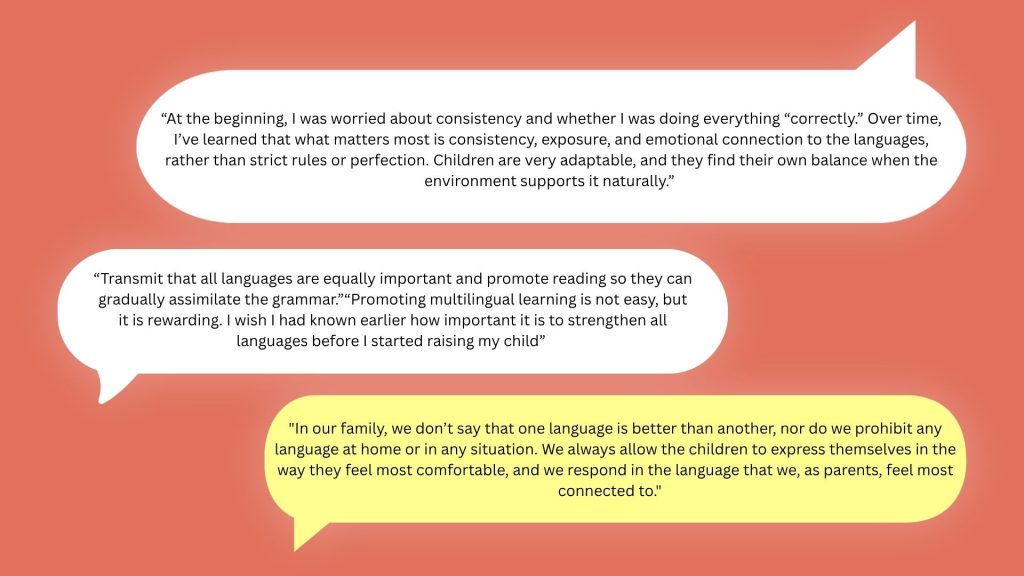
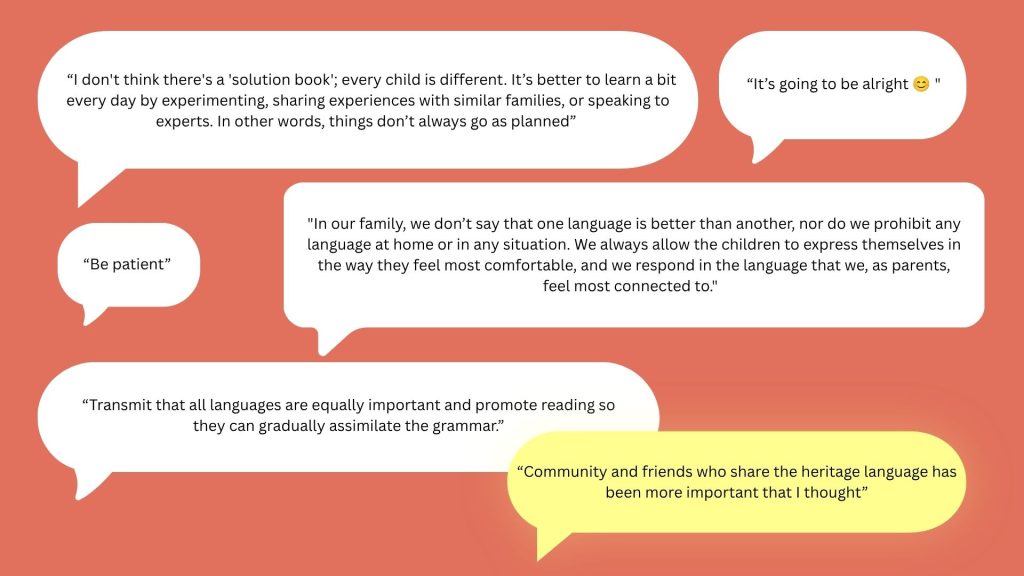
Every home and every child is unique, with the languages spoken within, the small traditions passed down, habits, inside jokes, and favourite dishes. But no one understands a multilingual family better than another multilingual family. In our questionnaire, we invited the families to share a piece of advice or a few words with other families you wish you had heard before.
These are some of the messages shared from parents to parents:
6. Bank of resources
In the questionnaire, many families expressed, how they wish there would be practical resources, that would support multilingual family life. There were a lot of interest especially in finding reliable information, community support, different events and different materials that help children maintain and develop their languages in everyday life.
For this reason, we had an idea to create a small Bank of Resources for families and for anyone interested in learning more about these topics. The purpose of this section is to bring together different types of tools for support materials in one accessible place, where they would be easy to find and use.
These resources include different guides, websites, groups and events in the Metropolitan area, that can support multilingualism in daily life. They are useful for different stages of family life and language learning. Some of the materials are designed specifically for parents and guardians, while some are targeted more to educators working with multilingual children and families, but still contain a lot of useful information anyone can utilize.
After each guide, material or event, there is a mention in which language(s) the resource is available in.
Guides:
– Bilingual Generation: 5 Methods for Raising Multilingual Children. A blog post from website that goes over 5 different family language methods (ENG, SPA). https://bilingualgeneration.com/blog/5-methods-for-raising-multilingual-children/
– Dived: Website of diversity in education. Mostly information for educators, but information that is also insightful for parents, from ECEC to later school path. (FIN, SME, SWE, ENG: unfortunately, not as broadly as in other mentioned languages). https://dived.fi/ –
– Familia Ry: Tools for speaking about racism and discrimination – A guide for families and professionals. (ENG). https://www.familiary.fi/uploads/7/1/8/2/71825877/rasisminvastainen_opas_netti_engl.pdf¨
– InfoFinland. A multilingual website with information about Finland and Finnish Educational System. (ARA, ENG, EST, FAS, FIN, FRA, RUS, SPA, SWE, TUR, UKR, ZHO) https://infofinland.fi/fi/education
– Omaperhe: Bilingual Family. Advice and tips for supporting the daily life of bilingual and multilingual child and their development. (ENG, FIN, SWE). https://omaperhe.fi/lapsi-1-6v/arki-ja-perhe/kaksikielinen-perhe
– Opetushallitus: Information about Early Childhood Education for parent and guardians with an immigrant background. (ARA, ENG, SOM, FIN, easy to read FIN, SWE). https://www.oph.fi/fi/tietoa-varhaiskasvatuksesta-maahanmuuttotaustaisille-vanhemmille-ja-huoltajille
– Multilingual Families: Website that offers recourses for parents and educators. (ENG). https://multilingual-families.com/
– National Literacy Trust: Understanding multilingualism in the early years. Text and resources. (ENG). https://literacytrust.org.uk/resources/understanding-multilingualism-early-years/
Only by order (FREE):
– Folktinget: Ge ditt barn en gåva – Anna lapsellesi lahja – A guide for families about bi- and multilingualism. (FIN, SWE)
– Latomaa, S. (2012). Speaking many languages: A valuable resource – A guide for families. Order through: sirkku.latomaa@uta.fi (Available in 25 different languages). Available in Ninho’s next newsletter in: ENG, FIN, SPA.
Groups:
– Familia Ry: Be-lingual Language Clubs. Activities are planned mostly for 2–6-year-old children, but everyone is free to join (Language clubs might change yearly, since they depend on club-leading volunteers and a minimum of 5 families to join). https://www.familiary.fi/belingual-language-clubs.html
– Heritage Language Course also known as “Kotikieli”, is offered by municipalities. From 1st grade on. Groups are voluntary participation, free access and after-school classes that help children with minority language. -> Usually registered for heritage language groups when registering for primary education.
– PICNIC Family Encounters: is a series of weekly meetings for families with small children in Helsinki and Espoo that speak Spanish. (minimum of 6 families) https://www.ninho.fi/picnic/ (SPA)
– Satakielikuukausi: annual Spring events all over Finland that celebrate multilingualism. https://satakielikuukausi.fi/info/
– Hola, Tampere: Organisation that promotes Spanish language and culture in Tampere through different events. https://odoo.holatampere.fi/en (SPA)
– LillaLuckan Family Cafés: “An opportunity for families to meet in a space where children can play and practise their social skills. The family cafés are aimed at children of different ages, and families at different stages of life.” (SWE, ENG, PT-BR, SPA, UKR, etc.)https://barnkultur.luckan.fi/helsingfors/familjecafeer/
– KOLIBRÍ: Multicultural and multilingual family festival. Events and workshops in many languages! https://www.kolibrifestivaali.org/
Notes
- Respondents’ quotes and questions had been translated into the language of the article.
June 1st, 2026
Article written by Inés De Luis Moro (HY) and Tinka Kukkamäki (TAU).
Sources
Alarcón Utrera, A., B. & Nieto Moreno de Diezmas, E. (2023). Speaking in nobody’s mother tongue: English immersion at home as a family language policy. Ampersand (Oxford, UK), 2023-12, Vol. 11, p.100135, Article 100135. https://www.sciencedirect.com/science/article/pii/S2215039023000279?via%3Dihub
Alisaari, J. (2018). Monikielisyyden tukeminen varhaiskasvatuksessa. Opetushallituksen julkaisu yhteistyössä tutkijan kanssa. Turun yliopisto.
Arnaus Gil, L., Müller, N., Sette, N. & Hüppop, M. (2021). Active bi- and trilingualism and its influencing factors. International multilingual research journal, 2021-01, Vol.15 (1), p.1-22. https://romanistik.uni-wuppertal.de/fileadmin/romanistik/pdf/Arnaus_Gil_et_al__2020_.pdf
Barron-Hauwaert, S. (2004). Language Strategies for Bilingual Families: The One-Parent-One-Language Approach. Clevedon; Buffalo: Multilingual Matters.
Connaughton-Crean, L., & Ó Duibhir, P. (2025). ‘We are always planning trips to Poland’: the influence of transnational family life on the family language policy of Polish-speaking families in Ireland. Journal of Multilingual and Multicultural Development, 46(9), 3166–3180. https://doi.org/10.1080/01434632.2024.2331746
Hollebeke, I., Struys, E., & Agirdag, O. (2023). Can family language policy predict linguistic, socio-emotional and cognitive child and family outcomes? A systematic review. Journal of Multilingual and Multicultural Development, 44(10), 1044–1075. https://doi.org/10.1080/01434632.2020.1858302
Johnsen, R., V. (2021). ‘Then suddenly I spoke a lot of Spanish’ – Changing linguistic practices and heritage language from adolescents’ points of view, International Multilingual Research Journal, 15:2, 105-125, DOI: 10.1080/19313152.2020.1821320
Kircher, R. (2022). Intergenerational language transmission in Quebec: patterns and predictors in the light of provincial language planning. International Journal of Bilingual Education and Bilingualism, 25(2), 18–435. https://doi.org/10.1080/13670050.2019.1691499
Lehtonen, H. (2021). Kielitaitojen kirjo käyttöön, limittäiskieleilyä luokkaan: Diversity of linguistic expertises and translanguaging in the classroom. AFinLA-e: Soveltavan kielitieteen tutkimuksia, 2021-10 (13).
Verhagen, J., Kuiken, F. & Andringa, S. (2022). Family language patterns in bilingual families and relationships with children’s language outcomes. Applied psycholinguistics, 2022-09, Vol.43 (5), p.1109-1139.