Building a More Democratic and Inclusive Children’s Culture Sector
Kulttuurikeskus Ninho continues to fortify its decade-long mission to develop a more multicultural and plurilingual children’s culture in Finland by offering free training programs for professional workers in the children’s culture sector. This year Ninho celebrates its 10th anniversary, continuing to create spaces where families, artists, and communities come together to experience, learn, and celebrate the richness of multilingual and multicultural childhoods in Finland.
Over the past five years, Ninho has been offering training and capacity-building opportunities for artists, educators, and cultural workers in the children’s culture sector — and this year, across three workshops, the participants, shared the strong interest and urgent need for these kinds of spaces in the field. In these times, creating spaces where professionals from the children’s culture sector can come together to analyse, discuss, reflect, and develop strategies for how to continue working is not just valuable. It is necessary.
In 2026, thanks to the continued support of the Pluralismisäätiö Foundation for the second-year running, we continued our Strength Capacity Building Training Program to create a more democratic and inclusive children’s culture sector, fostering intercultural dialogues and enhancing understanding through positive community engagement.
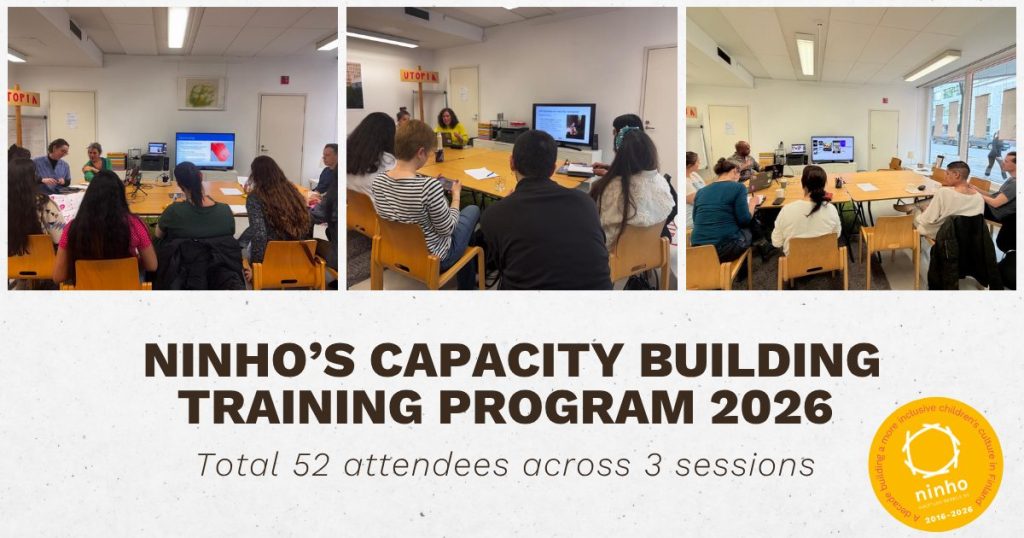
We welcomed a total of 52 participants to the training sessions. The feedback collected highlights the value of the programme. Over 90% of respondents rated the workshops as fair, valuable, or very valuable. More than 80% said the topics were closely aligned with their interests and professional practice, while the remaining participants found them at least somewhat relevant. Participants also rated highly the contribution of the workshops to their personal and professional development, noting that the facilitators explained the content in a clear and accessible way. Most importantly, the overall feedback shows that participants are likely or very likely to apply the knowledge and skills gained in their own practice, which is ultimately the main purpose of these sessions.
The Spring intensive program offered three free workshops for professionals, bringing together artists, librarians, event producers, project managers, students, teachers, and parents from different parts of Finland — all united by a shared commitment to creating cultural spaces that reflect the diversity of our communities. The sessions were held in English and in hybrid format — physically at the office space of Globe Art Point in Helsinki — on 26 May, 2 June, and 9 June 2026 respectively. Kolibrí Festivaali artists, Ninho volunteers, and Ninho members were also invited to participate, so they could strengthen and enrich their own artistic proposals and practices
The three workshops each addressed a distinct and essential dimension of inclusive cultural work:
Building Community Centered Actions was facilitated by Eurídice Hernández Gomes, Researcher and PhD Candidate, and Laura Gazzotti, co-founder and Artistic Director of Kolibrí Festivaali. Using Kolibrí Festivaali itself as a live case study, the session explored what it truly means to design and implement participatory cultural initiatives — translating concepts like conviviality, belonging, and participation into concrete cultural actions that respond to the real needs and diversity of communities. Participants particularly valued the practical approach of the session, appreciating the opportunity to learn more about Kolibrí Festival up close and to share and discuss with fellow participants. The conversation around the differences between community-based and community-centered approaches sparked especially rich reflection — a distinction that many found both eye-opening and immediately applicable to their own work.
From Communication to Belonging was facilitated by Marta Bermúdez, Communication and Diversity Bridge. The workshop invited cultural workers and creators to rethink how they communicate — offering practical tools and strategies for developing more inclusive and accessible messages for all children and families, regardless of language, background, or experience. Participants left with a deeper understanding of what non-violent communication and belonging truly mean in practice, and with concrete strategies they felt ready to apply in their own cultural spaces. The space and grace offered to learn together was something participants highlighted as particularly meaningful.
Strategic Design of Collaborative Action was facilitated by Leonardo Custódio, PhD and Associate Professor for Communication for Development at Malmö University, Sweden. The workshop addressed one of the most pressing challenges facing cultural organisations today — how to collaborate strategically and sustainably, particularly for immigrant-led initiatives navigating barriers to integration, funding, and democratic participation. The workshop translated research into practical tools for building trust, fostering dialogue, and designing collaborative actions that strengthen the field. The clear grounding in research, including practical references to numbers and Finnish law, was highlighted by participants as especially helpful — giving them concrete tools and strategies to bring back to their organisations and collaborative processes.
The results have been promising across the three workshops, reflecting strong interest in the topics and the relevance of this work to the field. The engagement was active, and the sessions were well received throughout. Each of the sessions brought together the knowledge, experience, expertise, and insights of Ninho and other professionals in the field — creating a space for genuine exchange and collective learning.
These trainings are a part Ninho’s ongoing commitment to keep building together, step by step, towards a more inclusive and democratic children’s culture. A more democratic and inclusive children’s culture sector doesn’t happen by itself — it is built, step by step, through collaboration, through honest conversation, and through the people who show up because they believe that every child deserves to see themselves reflected in the culture around them.